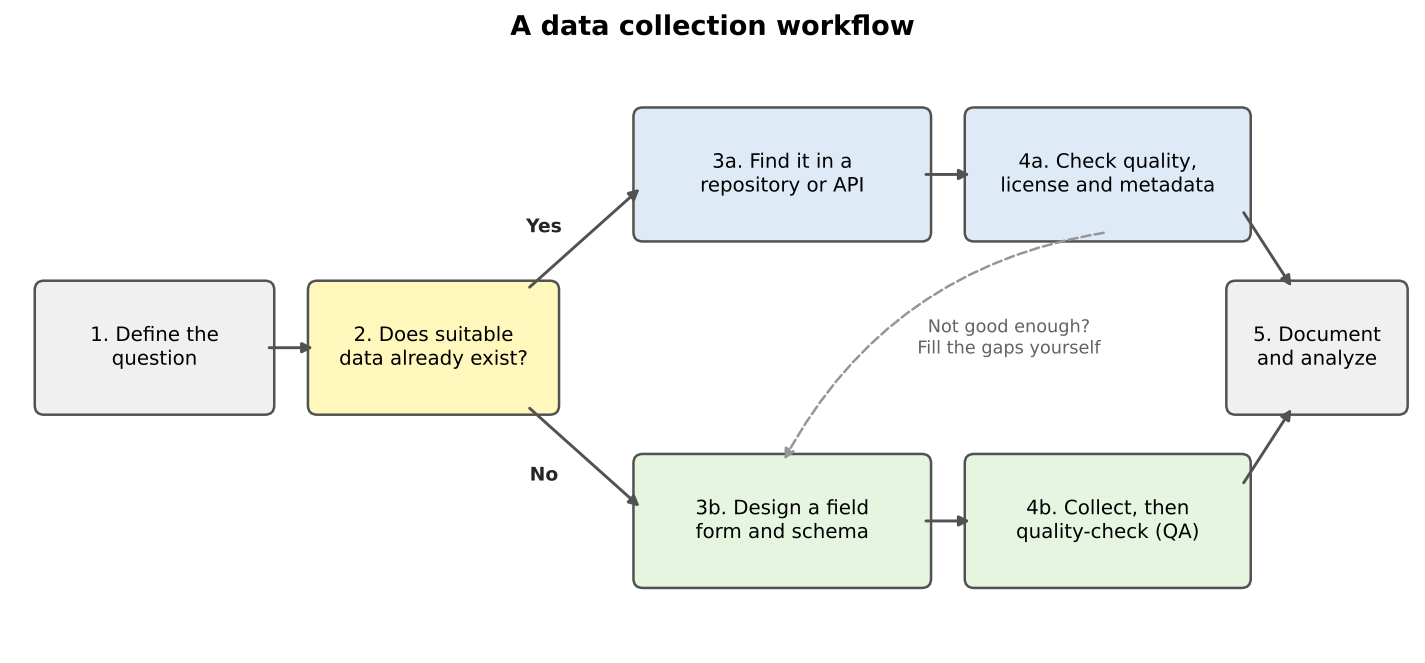
Image 1 of 1: ‘Flow diagram. Step 1, define the question, leads to step 2, does suitable data already exist? If yes, step 3a, find it in a repository or API, then step 4a, check quality, license and metadata. If no, step 3b, design a field form and schema, then step 4b, collect and quality-check. Both paths end at step 5, document and analyze. A dashed arrow from 4a to 3b says: not good enough? Fill the gaps yourself.’
A data collection workflow.
Figure 2
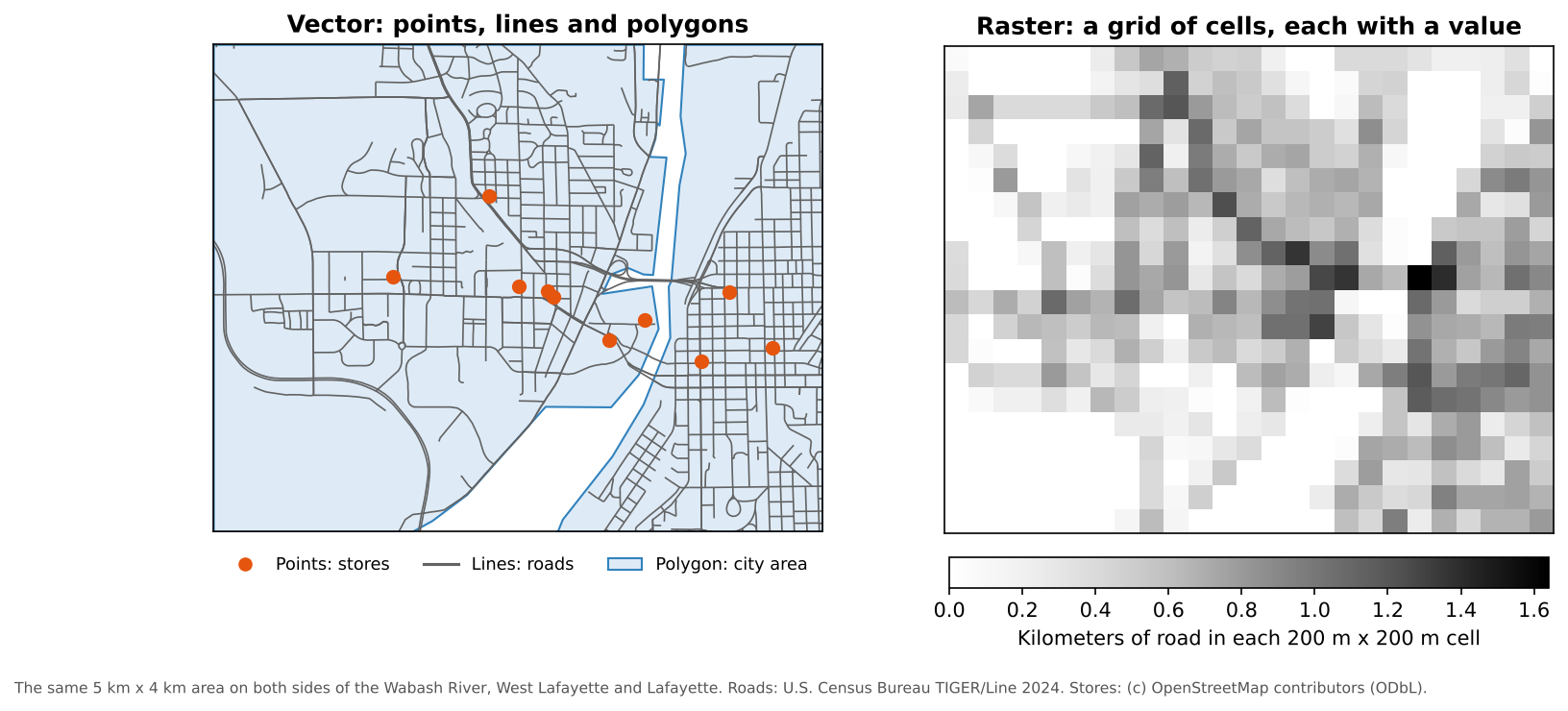
Image 1 of 1: ‘Two panels of the same 5 by 4 kilometer area of West Lafayette and Lafayette. Left, vector: orange store points, gray road lines and a light blue city polygon. Right, raster: a grid of 200 meter gray cells, darker where there is more road length in the cell, so the road pattern appears as a blocky texture.’
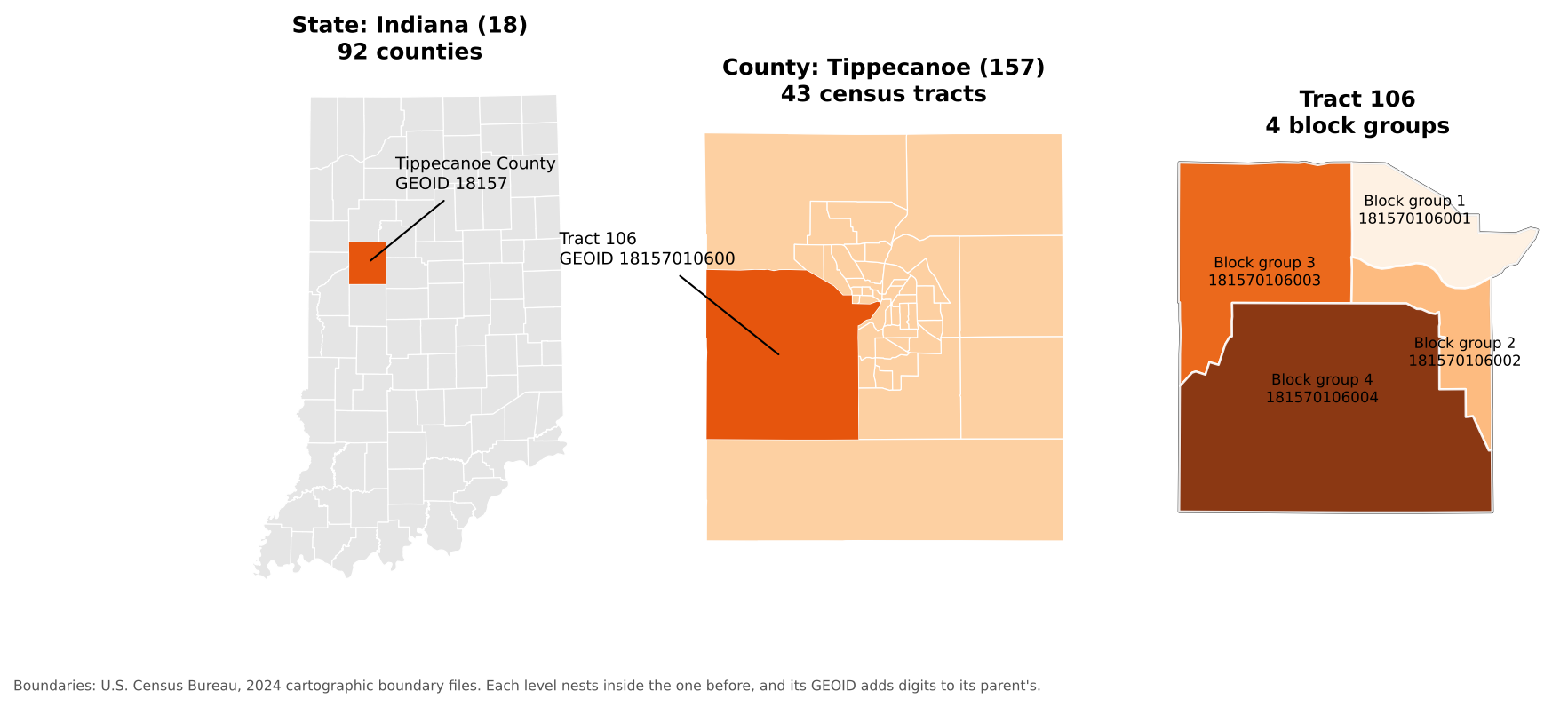
Image 1 of 1: ‘Three panels. Left: Indiana's 92 counties, with Tippecanoe County, GEOID 18157, highlighted. Middle: the 43 census tracts of Tippecanoe County, small in the cities and large in rural areas, with tract 106, GEOID 18157010600, highlighted. Right: tract 106 divided into four block groups with GEOIDs 181570106001 to 181570106004.’
Census geographies nest inside each other.
Figure 2
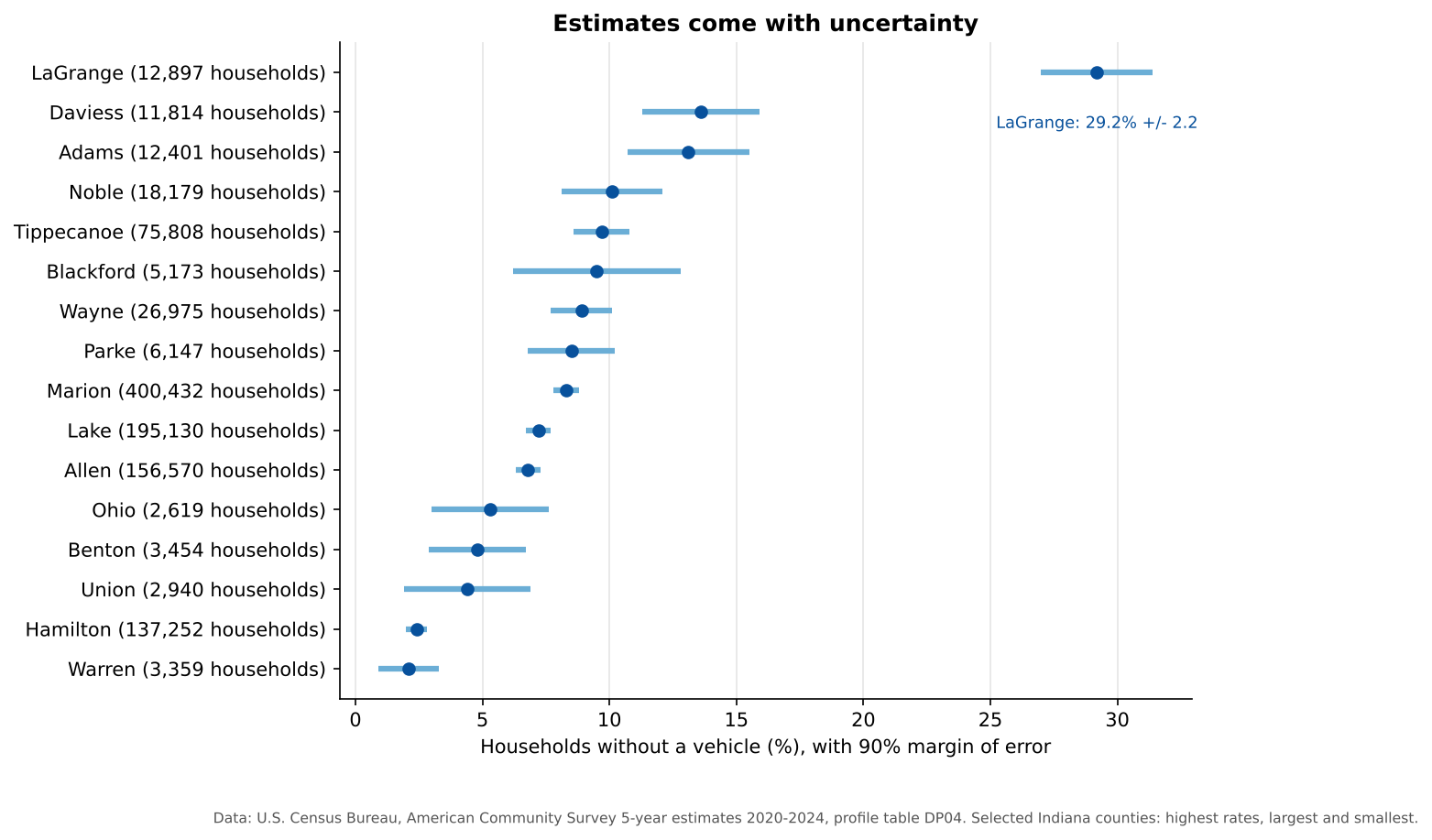
Image 1 of 1: ‘Dot plot of the percent of households without a vehicle in 16 Indiana counties, each with a horizontal error bar. LaGrange County is far above the rest at 29.2 percent, plus or minus 2.2. Large counties such as Marion, Lake, Allen and Hamilton have very short error bars. Small counties such as Ohio, Union, Benton, Warren and Blackford have wide error bars spanning several percentage points.’
ACS estimates with their margins of error.
Figure 3
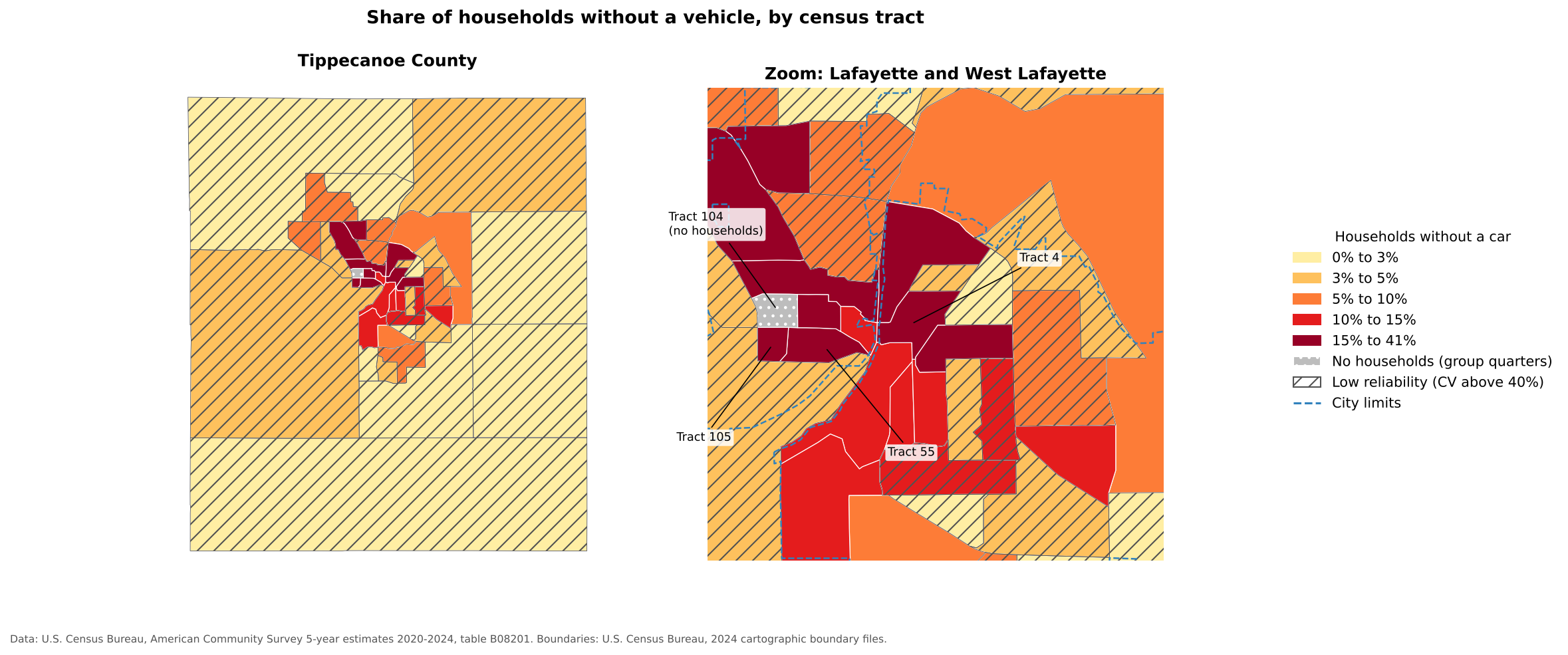
Image 1 of 1: ‘Two choropleth maps of the share of households without a vehicle by census tract, in five classes from light yellow (0 to 3 percent) to dark red (15 to 41 percent). Left, all of Tippecanoe County: rural tracts are light and many are hatched as low reliability. Right, a zoom on Lafayette and West Lafayette: the darkest tracts are near downtown Lafayette and the Purdue campus, such as tracts 4, 55 and 105. Tract 104, on campus, is gray because it has no households.’
Households without a vehicle by census tract in
Tippecanoe County.
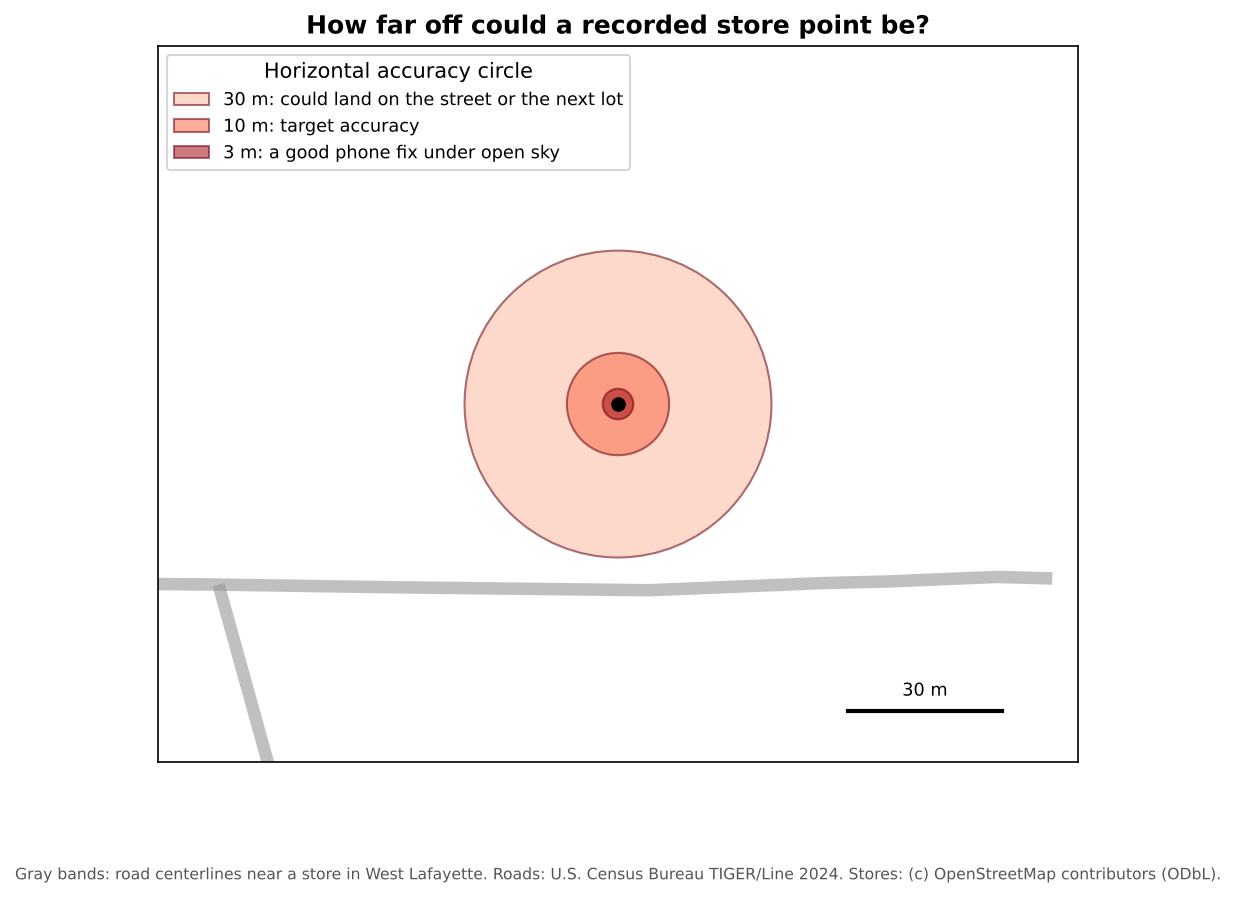
Image 1 of 1: ‘A store location in West Lafayette drawn as a black dot, surrounded by three accuracy circles: 3 meters (a good phone fix under open sky), 10 meters (the target), and 30 meters, which reaches toward the road and neighboring lots. A scale bar shows 30 meters.’